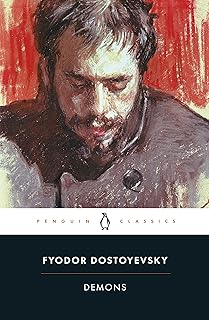
When exploring the vast and profound world of Dostoevsky books, readers often begin with the titanic Crime and Punishment or the spiritual epic The Brothers Karamazov. Yet, nestled between these giants lies a work of equal ferocity and foresight: Demons: A Novel in Three Parts. Also known as The Possessed, this 1872 novel is Dostoevsky's most direct and scathing examination of the political and ideological turmoil brewing in 19th-century Russia. It is not merely a story but a prophetic warning, a psychological thriller woven from the threads of philosophy, politics, and human desperation. For those seeking to understand the darker currents of classic Russian literature, Demons is an indispensable, if challenging, read.
This guide delves into the heart of Demons, exploring its genesis, its complex cast of characters who embody radical ideas, and the terrifyingly relevant themes of nihilism and revolutionary chaos. We will uncover why this novel, perhaps more than any other by Dostoevsky, serves as a crucial bridge between the individual psychological torment of his earlier works and the broader societal diagnosis of his final masterpiece.
The Genesis of a Prophetic Nightmare: Dostoevsky's Inspiration
To fully appreciate Demons, one must understand the context from which it erupted. Dostoevsky wrote the novel in the early 1870s, a period of intense social ferment in Russia. The old feudal order was crumbling, and new, radical ideologies imported from the West—particularly nihilism and utopian socialism—were captivating the disillusioned youth. Dostoevsky, a former political prisoner himself, viewed these movements with profound horror. His fear was crystallized by a real-life event: the 1869 murder of a student by the revolutionary cell of Sergei Nechaev. The Nechaev affair, with its cold-blooded brutality and totalitarian ethos, became the direct catalyst for Demons.
In this novel, Dostoevsky channels his intimate knowledge of the radical mind and his apocalyptic fear for Russia's soul. He moves beyond the individual criminal, as in Crime and Punishment, to depict the crime of an ideology—a collective possession by destructive ideas. The setting, a provincial town thrown into chaos by a group of plotters, becomes a microcosm for the entire nation. This focus on ideological contagion makes Demons a cornerstone of political philosophy novel and a stark departure from simpler 19th-century fiction.
Unpacking the Cast: Ideology Made Flesh
The power of Demons lies in its characters, each representing a facet of the ideological sickness Dostoevsky diagnosed. They are not realistic portraits but intense archetypes, making the philosophical conflict visceral.
- Pyotr Stepanovich Verkhovensky: The orchestrator of chaos. A cynical, manipulative nihilist, he is directly modeled on Sergei Nechaev. He believes in nothing but destruction for its own sake and uses revolutionary rhetoric as a tool for personal power, expertly manipulating the other characters like puppets.
- Nikolai Stavrogin: The novel's enigmatic, central figure. Handsome, intelligent, and wealthy, Stavrogin suffers from a profound spiritual emptiness—a boredom so deep it leads him to commit horrific acts. He represents the "great individual" whose lack of positive belief creates a vacuum filled by demons like Pyotr Stepanovich. His famous confession, the "Stavrogin's Confession" chapter, is a harrowing journey into absolute moral abyss.
- Ivan Shatov: The Slavophile. A former radical who has rediscovered his faith in God and the unique spiritual destiny of the Russian people. He stands as a direct ideological opponent to the nihilists, embodying the positive creed that Dostoevsky himself leaned toward.
- Alexei Kirillov: The logical nihilist. He takes the idea of human self-will to its ultimate conclusion, believing that by committing suicide purely to assert his own freedom from fear, he will become a "man-god." His storyline is one of the most profound and tragic explorations of nihilism literature has ever produced.
Through these and other figures, Dostoevsky demonstrates how abstract ideas, when divorced from morality and faith, become literal demons that possess and destroy human beings. The novel's original Russian title, Besy, means "demons" or "imps," referring explicitly to this spiritual possession.
Core Themes: Nihilism, Revolution, and the Russian Soul
Demons is a dense forest of ideas. Its primary themes are as urgent today as they were 150 years ago.
The Seduction and Horror of Nihilism
At its core, the novel is a dissection of nihilism—the rejection of all religious and moral principles. Dostoevsky shows nihilism not as a brave intellectual stance but as a spiritual disease that leads to logical absurdity (Kirillov) or pure, amoral violence (Pyotr Stepanovich). It is the void that makes society susceptible to totalitarian promises.
The Psychology of Revolution
Dostoevsky provides a masterclass in the group dynamics of revolution. He reveals how revolutionary movements often attract not idealists, but the bored, the resentful, and the power-hungry. The plot's escalation from silly secret meetings to arson and murder is a chillingly accurate portrayal of how radicalization operates.
The Search for Faith and Meaning
In counterpoint to the nihilism, the novel passionately argues for the necessity of faith. Characters like Shatov and the elderly chronicler, Stepan Trofimovich, in his final moments, point toward a Christian, specifically Russian Orthodox, answer to the crisis of meaning. This spiritual seeking is a hallmark of all great Dostoevsky books.
Why Read Demons Today?
One might ask why a novel about 19th-century Russian radicals remains essential. The answer is simple: Demons is less about a specific historical moment and more about a perennial human condition. It is a blueprint for understanding ideological fanaticism, political violence, and the spiritual malaise that enables them. In an age of polarized politics, online radicalization, and widespread existential anxiety, Dostoevsky's diagnosis feels unnervingly contemporary. The novel teaches us to look beyond the slogans and identify the human motivations—the vanity, the boredom, the despair—that drive destructive movements.
How to Approach This Challenging Masterpiece
Demons is not an easy read. Its large cast, complex plot, and dense philosophical dialogues can be daunting. Here is some advice for the journey:
- Start with Context: A brief overview of the Nechaev affair and 19th-century Russian nihilism will greatly enrich your understanding.
- Embrace the Chaos: The novel's first part deliberately feels fragmented and confusing, mirroring the disordered state of the town and the characters' minds. Persist.
- Focus on the Ideologies: Try to see each major character as the embodiment of an idea. Ask yourself: what belief does this person represent?
- Utilize a Good Edition: The translation by Richard Pevear and Larissa Volokhonsky is widely praised for its fidelity to Dostoevsky's rough, urgent style. A version with character lists and notes is invaluable. You can find a definitive edition among our curated vintage classics collection.
For readers captivated by the intense, idea-driven world of Demons, delving deeper into Dostoevsky's oeuvre is a natural next step. This novel acts as a perfect bridge to his final and greatest synthesis, The Brothers Karamazov, where the conflicts staged in Demons are revisited with even greater spiritual depth.
Conclusion: The Unsettling Power of Demons
Demons: A Novel in Three Parts stands as one of Dostoevsky's most courageous and unsettling works. It is a novel that stares unflinchingly into the abyss of ideological possession and forces the reader to do the same. While it may lack the tight, detective-like plot of Crime and Punishment or the grand theological architecture of The Brothers Karamazov, it compensates with raw prophetic power and philosophical intensity. It is an essential, if demanding, pillar in the library of Dostoevsky's major works. To read Demons is to gain a terrifyingly clear lens through which to view the forces that continue to threaten the human spirit and the body politic. It is not just a classic of 19th-century fiction; it is a vital warning for the 21st century.