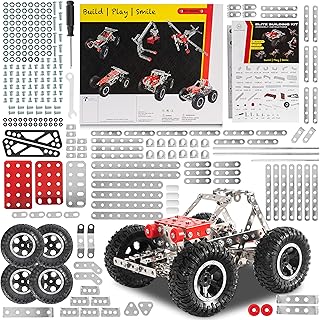
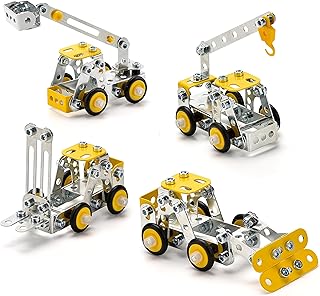
For over a century, the name Erector Set has been synonymous with creativity, engineering, and hands-on learning. More than just a toy, it's a foundational tool that has introduced generations of children to the principles of mechanics, structural integrity, and problem-solving. From its humble beginnings to its modern incarnations, the Erector Set represents a unique blend of play and education, making it a timeless classic in the world of STEM toys. This guide delves into the rich history of this iconic building system and explores the enduring benefits it offers for cognitive and skill development.
The Birth of an Icon: A.C. Gilbert's Vision
The story of the Erector Set begins in 1913 with inventor Alfred Carlton Gilbert. An accomplished magician and Olympic gold medalist in pole vaulting, Gilbert was also a Yale-trained medical doctor. His diverse background fueled his passion for creating educational toys. While traveling on a train, he was inspired by the steel girders used in constructing electrical towers. He envisioned a construction toy that would allow children to build their own miniature versions of these impressive structures. His creation, originally marketed as the "Mysto Erector Structural Steel Builder," was an instant success. It stood out from wooden block sets of the era by featuring real metal beams, nuts, bolts, and even a small electric motor, enabling dynamic, moving creations.
Evolution Through the Decades: From Metal Girders to Modern STEM
The classic Erector Set of the early 20th century was characterized by its stamped steel strips with regular holes, metal gears, pulleys, and later, DC motors. For decades, it was the premier engineering toy, often advertised with ambitious builds like bridges, ferris wheels, and cranes. The brand changed hands several times throughout the latter half of the century, facing competition from new plastic building systems. However, its core ethos of mechanical construction endured. Today, modern Erector Sets have evolved to align with contemporary educational toys standards, often incorporating solar panels, programmable controllers, and challenges aligned with robotics competitions. This evolution ensures its relevance, teaching not just static construction but also principles of energy, motion, and automation.
Core Educational Benefits: Building More Than Just Models
Developing Spatial Reasoning and Engineering Concepts
Working with an Erector Set requires children to think in three dimensions. They must interpret 2D diagrams to create 3D objects, a crucial skill in fields like architecture, engineering, and surgery. The process of assembling beams with nuts and bolts teaches fundamental engineering concepts: structural stability, load distribution, and the relationship between design and function. Unlike snap-together blocks, the mechanical fastening in an Erector Set provides a more realistic simulation of how real-world structures are built, offering a deeper understanding of tension, torque, and material strength.
Fostering Problem-Solving and Perseverance
Construction is rarely a linear process. A model might wobble, a gear might not mesh, or a motor might not have enough torque. These are not failures but valuable learning opportunities. An Erector Set challenges users to diagnose issues, hypothesize solutions (e.g., adding a brace, repositioning a gear, redistributing weight), and test their modifications. This trial-and-error cycle builds critical problem-solving skills and resilience, teaching children that persistence is key to overcoming obstacles—a lesson applicable far beyond the playroom.
Enhancing Fine Motor Skills and Patience
The act of handling small nuts, bolts, and metal pieces requires precise finger movements and hand-eye coordination. Tightening a bolt to just the right degree without stripping it is a skill that develops dexterity and control. Furthermore, following complex instructions for a multi-step build cultivates patience, attention to detail, and the ability to follow sequential procedures, all of which are vital for academic and professional success.
Erector Sets in the Modern STEM Landscape
In today's educational framework, the Erector Set is recognized as a premier building toy for STEM (Science, Technology, Engineering, and Mathematics) learning. It provides a tangible, kinesthetic entry point into abstract concepts. For example, building a geared crane illustrates mechanical advantage. Adding a motor introduces basic electrical circuits and energy conversion. Advanced kits that include solar panels or programmable modules bridge the gap to robotics and coding. This hands-on application helps solidify theoretical knowledge learned in classrooms, making it an invaluable tool for project-based learning and sparking long-term interest in technical careers.
Choosing the Right Erector Set for Your Child
With various options available, selecting an appropriate set is important. Consider the child's age, experience, and interests. For younger beginners (ages 6-8), look for sets with larger, simpler pieces and fewer components to build confidence. Intermediate builders (ages 8-12) can handle sets with 300-500 pieces that include motors to create moving models like cars or windmills. For teens and advanced enthusiasts, complex kits with multiple motors, remote controls, or programming interfaces offer endless challenges. The key is to match the complexity to the child's skill level to ensure engagement without frustration, keeping the spirit of engineering exploration alive.
A Lasting Legacy of Innovation
From A.C. Gilbert's original vision to the high-tech STEM kits of today, the Erector Set has maintained its core mission: to empower young minds to build, create, and understand the mechanics of the world around them. It is more than a relic of the past; it is a continuously evolving platform that adapts to the educational needs of each new generation. By combining the tactile satisfaction of metal construction with the intellectual challenge of engineering principles, the Erector Set remains a powerful tool for nurturing the innovators, problem-solvers, and engineers of tomorrow. Its legacy is built, quite literally, one bolt at a time.