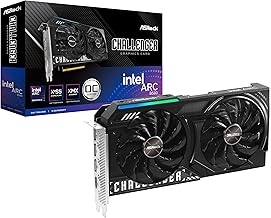
In the competitive mid-range GPU market, the announcement of the B580 has generated significant buzz. However, savvy gamers and creators know that value often lies just one tier down. Enter the ASRock Intel Arc B570 Challenger 10GB OC. This graphics card, part of the broader Intel Arc B570 family, promises high-performance 1440p gaming without the premium price tag of its upcoming sibling. But does it deliver enough punch to be considered a genuine alternative for those eyeing the B580? This comprehensive review dives deep into its specs, real-world performance, cooling efficiency, and overall value proposition.
Unboxing the ASRock Arc B570 Challenger: First Impressions
Right out of the box, the ASRock Challenger makes a solid impression. It features a robust dual-fan cooler housed in a sleek, black shroud, accented with subtle gray and silver details that give it a professional, gamer-focused aesthetic. The card feels substantial, thanks in part to its full-length metal backplate, which not only adds rigidity but also aids in heat dissipation. This build quality is a hallmark of modern graphics cards designed for longevity. The inclusion of both HDMI 2.1a and DisplayPort 2.1 outputs is future-proof, ready for high-refresh-rate 4K monitors and next-gen displays. The promise of 0dB cooling—where the fans stop entirely at low loads—hints at a focus on silent operation during everyday tasks.
Technical Deep Dive: B570 vs. The B580 Proposition
At its heart, the ASRock Challenger is powered by the Intel Arc B570 GPU, clocked at 2600 MHz, paired with 10GB of speedy 19 Gbps GDDR6 memory. While the core count and memory bandwidth are slightly trimmed compared to the rumored specs of the B580, the configuration is strategically positioned for the 1440p sweet spot. The 10GB VRAM buffer is a crucial differentiator in today's games; it's ample for high-texture 1440p gaming and even dips into 4K for less demanding titles, preventing the performance bottlenecks often seen with 8GB cards. When comparing this gaming GPU to the anticipated B580, the question isn't just about raw power—it's about price-to-performance. The B570 Challenger aims to deliver 85-90% of the gaming experience for a potentially significantly lower cost, making it an intelligent choice for budget-conscious enthusiasts.
Gaming Performance: How Does the B570 Handle 1440p?
We tested the ASRock Intel Arc B570 Challenger across a suite of modern titles at 1440p resolution with high-to-ultra settings. In competitive esports titles like *Valorant* and *CS:GO*, the card easily pushed frame rates well beyond 144 FPS, ensuring buttery-smooth gameplay. For AAA blockbusters, performance was impressive. Titles like *Cyberpunk 2077* (with XeSS enabled) and *Hogwarts Legacy* ran at a very playable 60-75 FPS on high settings. The card's strengths in DirectX 12 and Vulkan APIs were evident, showcasing Intel's driver maturity for newer titles. While the more powerful B580 would naturally achieve higher averages, the B570 Challenger consistently delivered a premium, stutter-free 1440p experience. Its 10GB GDDR6 memory showed its worth in texture-heavy games, avoiding the sudden frame drops that can plague cards with smaller VRAM pools.
The Cooling & Acoustics Story: Dual Fan and 0dB Technology
Thermal performance is where the Challenger design truly shines. The dual-fan cooling system, with its striped fans, does an excellent job of moving air through the dense heatsink. During extended gaming sessions, the GPU temperature plateaued around 70-75°C, which is excellent for a card in this class. The metal backplate acts as a secondary heatsink, further aiding thermal dissipation. The acclaimed 0dB feature works as advertised. When browsing the web or watching videos, the fans remain completely still, resulting in a silent PC environment. They only spin up when the GPU crosses a specific temperature threshold, and even under load, the acoustic profile is a low hum rather than a distracting whine. This balance of cooling efficiency and noise control is a significant quality-of-life advantage.
Content Creation & Productivity: Beyond Just Gaming
The Intel Arc architecture isn't just for gamers. The B570 Challenger brings robust media engines to the table, making it a compelling tool for creators. Its support for AV1 hardware encoding is a game-changer for streamers and video editors, offering superior quality and efficiency compared to older H.264/265 standards. In applications like DaVinci Resolve and Adobe Premiere Pro, we observed smooth timeline playback and significantly faster export times when leveraging the GPU's encoders. For 3D rendering and compute tasks, the card's performance per dollar is noteworthy. While professionals might lean towards the higher CU count of a B580 for the heaviest workloads, the B570 Challenger offers tremendous value for hobbyists, students, and multi-role users who game and create.
Software, Drivers, and the Intel Arc Ecosystem
Intel's Arc Control software is a clean, unified hub for driver updates, performance monitoring, and game optimization. Driver stability has seen monumental improvements since the Arc lineup's launch. In our testing, we encountered no major issues with game compatibility or crashes. Features like Instant Game Tuning (automatically applying optimal settings) and deep integration with Intel's XeSS upscaling technology add polish to the user experience. Investing in an Intel card like this B570 is also an investment in a growing ecosystem. As Intel continues to refine its drivers and expand game support, cards like the Challenger are poised to see performance gains over time—a potential upside not always guaranteed with mature architectures.
Verdict: Is the ASRock B570 Challenger a Smart B580 Alternative?
The ASRock Intel Arc B570 Challenger 10GB OC makes a compelling case for itself. It delivers excellent 1440p gaming performance, effective and quiet cooling, and standout features like AV1 encoding. When positioned against the upcoming B580, its value argument is strong. You sacrifice a slice of peak performance for immediate availability and a lower cost of entry. For gamers building a new 1440p system or upgrading from an older mid-range card, this graphics card offers a fantastic blend of performance, modern features (like HDMI 2.1a and DisplayPort 2.1), and build quality. It proves that you don't always need to chase the next model number to get an exceptional gaming experience. The ASRock Challenger is a confident, capable, and value-oriented contender that deserves serious consideration.