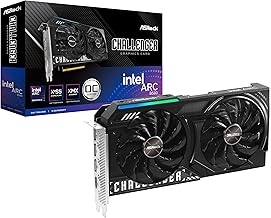
In the competitive landscape of mid-range graphics cards, the B580 has emerged as a compelling contender. Built on Intel's Arc architecture, this GPU promises a blend of performance and value, specifically targeting gamers and creators who need capable hardware without breaking the bank. This review dives deep into what the Intel Arc B580, like the WEELIAO GUNNIR model, brings to the table, analyzing its specs, real-world performance, and overall value proposition.
Understanding the Intel Arc B580 Architecture
The Intel Arc B580 is more than just a model number; it represents Intel's strategic push into the dedicated GPU market. At its core, the B580 leverages the Xe-HPG microarchitecture, designed to deliver efficient gaming and compute performance. A key feature of this architecture is its support for modern APIs like DirectX 12 Ultimate and hardware-accelerated ray tracing, putting it on par with contemporary offerings from competitors. For users building a new system or upgrading, the card's PCI-Express 4.0 interface ensures maximum bandwidth compatibility with modern motherboards, minimizing potential bottlenecks for data-intensive tasks.
Key Specifications and Features Breakdown
Let's unpack the hardware that defines the B580 experience. The standout spec is its generous 12GB of GDDR6 memory on a 192-bit bus. In today's gaming environment, where texture sizes and resolutions are ever-increasing, 12GB of VRAM is a significant advantage for 4K gaming and high-resolution texture packs. It provides ample headroom, reducing the likelihood of stuttering caused by VRAM overflow compared to 8GB cards.
The WEELIAO GUNNIR Intel Arc B580 Index, for instance, operates with a boost clock of 2670MHz, indicating strong out-of-the-box performance. The dual-fan cooling solution is crucial for maintaining these clock speeds under sustained load, keeping thermals and noise in check. Connectivity is handled by a standard set of outputs, including HDMI and DisplayPort, ready to drive high-refresh-rate 4K displays. This combination of specs positions the B580 firmly as a capable mid-range GPU.
Gaming Performance: 1080p, 1440p, and 4K
Performance is the ultimate test for any GDDR6 graphics card. For the B580, 1080p gaming is a breeze, easily pushing high frame rates in esports titles and well over 60 FPS in AAA games with high settings. The real sweet spot, however, is 1440p. Here, the 12GB frame buffer and capable compute units allow for smooth gameplay with details turned up, offering an excellent high-fidelity experience.
Venturing into 4K territory is where the B580's value shines. While it may not max out every new AAA title at 4K/Ultra, it is perfectly capable of delivering very playable 4K experiences by utilizing a mix of High settings and leveraging upscaling technologies like Intel's XeSS. This makes it a fantastic budget graphics card for entry-level 4K gaming or high-refresh-rate 1440p, a balance that is hard to find at its price point.
Content Creation and Productivity
Beyond gaming, the Intel Arc B580 shows its versatility in content creation. Applications that leverage GPU acceleration, such as DaVinci Resolve for video editing or Blender for 3D rendering, benefit from the card's architecture. The 12GB of VRAM is again a major asset, allowing for larger project files, more complex effects, and higher-resolution timelines without constant swapping to system RAM. For streamers, the built-in AV1 encoder is a future-proof feature, offering superior compression efficiency compared to older H.264/265 codecs, resulting in higher quality streams at lower bitrates.
Cooling, Power, and Build Considerations
A card's performance is only as good as its ability to sustain it. Models like the WEELIAO GUNNIR Intel Arc B580 Index utilize a dual-fan design to dissipate heat effectively. This typically results in good thermal performance with manageable acoustic levels, even during long gaming sessions. Power draw is reasonable for the performance class, usually requiring a single 8-pin or 8+6-pin PCIe power connector, making it compatible with a wide range of power supplies (a quality 550W-650W unit is recommended).
When considering a specific model like this one, it's important to check its physical dimensions to ensure it fits your PC case. The dual-slot design is common, but length can vary. The build quality, fan bearing type (e.g., fluid dynamic bearings for quieter operation), and backplate presence are factors that differentiate various Intel Arc B580 models from different board partners.
Market Position and Value Verdict
So, is the Intel Arc B580 worth it? Its position in the market is unique. It directly challenges similarly priced cards from AMD and NVIDIA by offering a compelling combination: modern feature support (PCIe 4.0, AV1 encoding), a generous 12GB VRAM buffer, and competitive rasterization performance. It excels as a budget-friendly gateway to high-resolution gaming and capable content creation.
For the price, you get a card that handles 1440p superbly and dabbles in 4K, all while being ready for future game technologies and streaming standards. If your priorities include future-proofing with ample VRAM, accessing modern media engines, and getting strong overall performance without paying a premium, the Intel Arc B580, in variants like the WEELIAO GUNNIR, presents a remarkably balanced and valuable option in the mid-range GPU segment.
Final Thoughts
The Intel Arc B580 is a statement of intent from Intel. It proves that a GDDR6 graphics card can deliver high-end features and respectable performance at a mid-range price. Whether you're a gamer looking to upgrade to 1440p or a creator needing capable GPU acceleration, the B580's 12GB of memory and efficient architecture make it a standout choice. Before purchasing, compare specific models from partners like WEELIAO GUNNIR for the best cooling solution and clock speeds to match your needs and chassis.